

Comparison of relationships between different personality types. Anima/animus.
Українською тут >>>
- Jung’s typology in the USA
- Jung’s typology in post-Soviet countries
- Comparison of relationships between types
With a thorough study of typology, it becomes obvious that we develop different relationships with different types of people: it is easy for us to get along with representatives of some types, but difficult with representatives of others.
Carl Jung wrote that the difference between types can cause misunderstandings between people: “The conscious attitude (main psychical function) is always in the nature of a Weltanschauung, if it is not explicitly a religion. It is this that makes the type problem so important. The opposition between the types is not merely an external conflict between men, it is the source of endless inner conflicts; the cause not only of external disputes and dislikes, but of nervous ills and psychic suffering.” (1)
When it comes to relationships in a couple between a man and a woman, the concept of anima/animus immediately comes to mind. In Jung's typology, anima/animus refer to a function that is opposite to the main function of the type and at the same time complements it. Anima/animus in typology are identical to the inferior function. (More about this here >>>) If the main function is extraverted, the anima or animus is introverted; if the main function is Sensation (S), the anima/animus is Intuition (N); if the main function is Thinking (T), the anima/animus is Feeling (F). Thus, we have the following pairs of functions: Se – Ni, Si – Ne, Fe – Ti, Fi – Te.
One can assume that the relationship between types whose main function corresponds to the partner's anima/animus should be special.
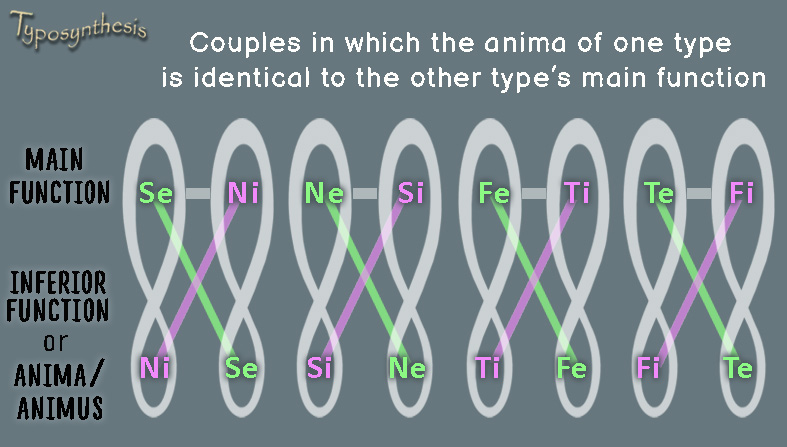
Here is what Carl Jung writes about the relationship between the types Se – Ni, Si – Ne, Fe – Ti, Fi – Te : “This dependence on the object seems to the introvert a mark of the greatest inferiority, while to the extravert the preoccupation with the subject seems nothing but infantile auto-eroticism. So it is not surprising that the two types often come into conflict. This does not, however, prevent most men from marrying women of the opposite type. Such marriages are very valuable as psychological symbioses” (1)
Jung’s close associate Marie-Louise von Franz said: “In marriage, as Jung points out, one tends to marry the opposite type ... That is one of the great blessings and sources of happiness in the early stages of a marriage; suddenly the whole weight of the inferior function is gone, one lives in a blessed oneness with the other, and every problem is solved!” (2)
Let's take a look at what modern typology researchers think about the relationships between types.
Jung’s typology in the USA. In the United States, Jungian typology is studied by MBTI proponents, as well as proponents of Depth Typology, which is based on the eight-function model of Jungian analyst John Beebe.
On the topic of intertype relationships, one can find a 2007 review article ‘Relationship Type Combinations’ by psychologist Vicky Jo. She writes: “Probably the most infamous type combinations for romantic involvement are those decreed by David Keirsey in Please Understand Me (1984). In this book, Keirsey takes the resolute stance that "opposites attract." The algorithm he outlines for each type in painstaking detail simply consists of mismatching every letter of a pair’s type code so these couples have no alphabet in common. His prescription has subsequently met with every possible reaction -- ranging from shock and horror to raging success.” (3) In other words, Keirsey believed that the ESTJ type pairs well with the INFP type, and the ENTJ type pairs well with the ISFP personality type.
Carl Jung distinguished eight basic psychological types, based on their main (dominant) function. To understand the correlation with Jung's eight types, I will identify the types only by the main function. For example, I will call the INFJ type and the INTJ type the Ni type, since Ni is the main function for both types. I will call the ESFJ type and the ENFJ type the Fe type, since both types have Fe as their main function.
After translating the MBTI type names into Jung's terms, we can see that Keirsey considered the same types as Jung to be compatible: types in which the inferior function (anima/animus) of one type is identical to the main function of the other type. These pairs of types are as follows: Se – Ni, Si – Ne, Fe – Ti, Fi – Te.
Vicky Joe continues: “What few people know is that Keirsey changed his formula in a lesser-known sequel, Portraits of Temperament (1988). In this treatment, Keirsey presents a different ideal. In the updated algorithm, he dismisses the first letter of the code as unimportant, matches the second letter, and MISmatches the third and fourth letters. This brand-new formula pairs NFJs with NTPs and STJs with SFPs, and so on.”
“Dr. John Beebe, curiously enough, happens to agree with Keirsey's original formula in his own investigation of relationships. He reprises Keirsey's first algorithm of having no letters in common… Beebe labels this particular kind of matching opposed codes ‘inverse relationships’ … He states that in this combination, each partner will "cradle" the other's anima/animus gently." (3)
Vicky Jo writes “Beebe concurrently introduces a competing algorithm. He states that ‘seduction’ most often occurs when a person meets their favorite process as the 5th process in another person. He indicates there is an overwhelming attraction between two processes in this combination: 1 + 5.” Such pairs of functions are Se – Si, Ne – Ni, Fe – Fi, Te – Ti. «According to Beebe, when dominant introverted iNtuiting (Ni) encounters dominant extraverted iNtuiting (Ne), it’s as if they magically combine to form a “giant iNtuition” together. Beebe suggests this compelling attraction is far more common than the inverse relationship he previously described, and claims that the sensation can be highly seductive.” (3) From Beebe's work, one can conclude that such relationships are initially attractive, and then repulsive, as many misunderstandings arise.
Bob McAlpine of Type Resources calls these pairs of types "dynamic opposite." Carol Shumate writes: “The type dyad that is perhaps the most susceptible to the attraction-repulsion component of the opposite attitudes is one that Bob McAlpine called dynamic opposites. This term refers to an interaction between two individuals of particular types... In this dyad, the two types have the two inner letters of the type code in common—the function coupling such as NT, SF, etc.—but differing first and last letters, I/E and J/P… Because of their shared functions, such types are often considered cognate types. They may frequently interact because they are drawn to the same professions, and for that reason, they tend to assume they understand each other—until they reach an impasse... The slightest of events can ignite large conflicts between individuals with these function hierarchies, but small events can also move the parties beyond it.” (4)
Let us summarize the labels of the various relationships between types, taking the Ni type as an example.
* Ni – Se: Ni-type relationship with Se-type - ‘inverse relationships’ (John Beebe). This is a relationship favorable for couples, in which “each partner will ‘cradle’ the other's anima/animus gently.”
Jung’s typology in post-Soviet countries. On the other side of the “Iron Curtain”, Jung’s typology developed differently. In the 1970s and 80s, in Lithuania, which was then part of the Soviet Union, a typology called Socionics was developed, which includes 16 types and is based on Jung's 8 functions. The founder of Socionics is Lithuanian sociologist and economist Ausra Augusta (Augustinavichiute), her type is ENTP. Unlike MBTI, Socionics uses an 8-function type model, that is, it studies the role of each of the 8 functions in the structure of a type, similar to the 8-function model of John Beebe. (more about the 8-function model in socionics here >>>) In addition, Socionics explores intertype relationships and studies how each of the 8 functions of one type interacts with each of the 8 functions of another type.
In 1991, the International Institute of Socionics was founded in Kyiv (Ukraine), where international conferences on Socionics are held annually. Socionics is taught at many universities in post-Soviet countries. Knowledge of Socionics helps in family counseling and in analyzing the psychological compatibility between staff members. Furthermore, Socionics was used to form teams for space missions. A paper entitled ‘Forecasting psychological, business and informational compatibility in space flights, in aviation and aerospace technologies’ was presented at the 9th Ukrainian Conference on Space Research. (5)
Comparison of relationships between different types based on Socionics. Below will be briefly presented the principle of intertype relationships, which is based on Socionic model and confirmed by numerous observations and experience of Socionics practitioners. Carl Jung distinguished eight basic psychological types, based on their main (dominant) function. To facilitate understanding and correlation with Jung's eight types, I will refer to the types by their main (dominant) function. For example, I will call the INFJ type and the INTJ type the Ni type, since Ni is the main function for both types. I will call the ESFJ type and the ENFJ type the Fe type, since both types have Fe as their main function. Furthermore, to simplify understanding, I will not use all eight functions in the type structure, but only two functions: the main and the inferior (anima/animus) functions. (More information about the anima as a function here >>>)
Let's consider some types of relationships for the Ni type (these are the INFJ and INTJ types, in which the Ni function is the main one).
* Ni – Se – relationships of duality (or dual relationships) – are considered best for long-term relationship in a couple.
* Ni – Si – parallel relationships – partners seem to live in parallel worlds. Such relationships are considered best for business collaboration.
* Ni – Ne – relationships of extinguishment – the strengths of one partner extinguish the strengths of the other. Such relationships are productive if people maintain a certain psychological distance.
* Ni – Ni – relationships of amplification – the partners' strengths coincide and magnify each other. More suitable for friendship or study; not effective for the marriage.
It is important to note that the Socionic interpretation of Jung's psychical functions differs from the interpretation of Jung's functions in the MBTI. In the English-speaking world, the understanding of the Jung's eight functions is based on the MBTI model. To determine Socionic compatibility between types, only Socionic understanding of Jung's 8 functions or types is suitable. Psychical functions in Socionics and MBTI can differ significantly, and some are completely opposite in content. Therefore, compatibility theory does not work in MBTI. To test the Socionic theory of intertype relationships on yourself, you need to determine your main psychical function in the Socionic model.
Here you can find a description of the four types (Se, Si, Ne, Ni) that correspond to the understanding of Jung’s psychical functions and types in Socionics. The types are described by levels of harmony >>>
Relationship combinations for the Ni-dominant type.
• Ni + Se – relationships of duality. Dualization is complete if the auxiliary functions of the types are opposite. If the auxiliary functions of the types are the same, the relationship is called semi-dual and has a different nature. Read more here >>>
In such a couple, the partners use their strengths to compensate each other's weak points. The Ni-type is grateful to the Se-type partner for supporting their weak Se-function. The Se-type is grateful to the Ni-partner for supporting their weak Ni-function. This contributes to the psychological harmonization of each partner. The partners can spend a lot of time together and get tired of each other.
Relationship dynamics. Initially, it can be difficult for these types to get to know each other better, because they are very different, have different paces of life, different interaction styles, and different interests. Attraction usually arises after situations in which they help each other with their strengths. The partners feel at ease together. In such a couple, there is often a feeling that one partner is an extension of the other. Such relationships do not change over time and can last a lifetime.
• Ni + Si – parallel relationships. Depending on the auxiliary function, there will be two different types of relationships. Read more here >>>
In such a couple, the partners' strengths partially compensate each other's weak points. The Ni-type needs support for his/her inferior Se-function (anima/animus), but the Si-partner can only partially cover this need, since his/her main Si-function only partially shares the qualities of the Se-function and, in most manifestations, is the opposite to the Se-function. The same thing goes for the Si-type, who needs support for his/her inferior Ne-function (anima/animus). The Ni-partner can only partially cover this need.
Relationship dynamics. Initially, these types show interest in each other. Communication at a far psychological (social) distance is quite pleasant. When getting closer, both partners get the impression that their interaction is too superficial, the partners do not understand each other's needs and unable to support each other. The situation worsens when they begin living together. They fail to understand each other's interests; what is important to one has no value to the other. Over time, the partners drift apart, and even living in the same territory, it may seem to them that they are living in parallel worlds.
Such relationships are more effective for interaction at a medium psychological (social) distance, for professional or business collaboration or for solving certain tasks.
• Ni + Ne – relationships of extinguishment. Depending on the auxiliary function, there will be two different types of relationships. Read more here >>>
In this couple, the strengths of one partner extinguish the strengths of the other. The Ni-function is antagonistic to the Ne-function, resulting in partners having different visions and different strategies. Partners devalue each other.
The partners' strengths cannot compensate for each other's weak points. The Ni-type needs support for his/her inferior Se-function (anima/animus). The Ne-type partner can't meet this need. The same applies to the Ne-type, who needs support for his/her inferior Si-function (anima/animus). The Ni-type partner can't meet this need. As a result, the couple experiences a "Sensation deficit"—a lack of Sensation (physical, material) support.
Relationship dynamics. In the early stages of a relationship, they share many common interests and topics they enjoy discussing. When communicating at a distance, they may feel like they understand each other perfectly and are a great match. However, as the distance reduces, each begins to realize that the other is doing everything wrong, and expects different behavior from the partner. The partner's motives are incomprehensible, and his or her goals seem unimportant. Interest in the partner quickly wanes. Mutual disappointment arises, along with condemnation of the partner's methods and approaches.
When living together, partners may struggle to meet basic physical needs and manage household chores (cooking, cleaning). They may try to dump household chores on each other, but this doesn't work, since both are Intuitive and both have a weak Sensation function. The relationship has a better prognosis if relatives help them with housekeeping, or if the couple has a good financial situation, allowing them to pay for cleaning and buy prepared meals.
• Ni + Ni – relationships of amplification. Depending on the auxiliary function, there will be two different types of relationships. If the partners' auxiliary functions coincide, their strengths are maximally enhanced. Read more here >>>
In this couple, the partners' strengths are amplified, but there is no support for their weak points. Since both are introverts, neither partner lacks the energy to engage with the outside world. Furthermore, each partner needs support for his/her inferior Se-function (anima/animus), but the other cannot meet this need. As a result, the couple experiences a " Sensation deficit"——a lack of Sensation (physical, material) support.
Relationship dynamics. Having a type in common between two people often creates instant rapport. They have a feeling of complete understanding, a sense of being on the same wavelength, as if they have met “their” person, when communicating there is often a surge of energy. However, the longer the communication, the more the partners get tired of each other, of oversaturating their main function and of one-sidedness. Since both are introverts, their life becomes too closed and monotonous.
When living together, partners may struggle to meet basic physical needs and manage household chores (cooking, cleaning), since both are Intuitive and both have a weak Sensation function. The relationship has a better prognosis if relatives help them with housekeeping, or if the couple has a good financial situation, allowing them to pay for cleaning and buy prepared meals.
Such relationships are best for friendship, teacher-student, and parent-child relationships. Relationships of amplification are especially beneficial for people who did not receive energy for their main function in childhood because their parents belonged to a different type. Such relationships are also useful for seeing oneself from an outside perspective, exploring one's strengths and weaknesses. Such relationships are not recommended for married life.
Interestingly, researchers of the Enneagram typology have also come to a similar conclusion regarding relationships between the same types. Studying various combinations of 9 Enneagram types based on the principle of complementarity, researchers found that same Enneagram personality type marriages occurred two times less often than statistically expected. "Birds of a feather" may flock together as friends, but apparently not in marriage. Enneagram compatibility study on 457 married couples is here >>>
Anzhelika Zabava, Typology Consultant
Last updated 17.01.2026
* *
1 - Psychological Types. A lecture delivered by Carl Jung, Territet, Switzerland, 1923.
2 – Marie-Louise von Franz, The inferior function. Chapter 1. A general characterization of the inferior function. (Seminar in Zurich, 1961)
3 - Vicky Jo, PhD in Depth Psychology, certified Master Practitioner of the MBTI. Article “Relationship Type Combinations” in ATPi Bulletin of Psychological Type, Vol.30, No. 3 (2007). www.scribd.com/document Also here typeinsights.blogspot.com and infj.com
4 - Carol Shumate, Projection and Personality Development Via The Eight-Function Model, 2021 ebrary.net
5 - Bukalov A.V.; Karpenko O.B.; Chykyrysova G.V. (2009). publishing.socionic.info