

Kinds of relationships between different personality types (inter-type relationships)
Українською тут >>>
- relationships of duality
- parallel relationships
- relationships of extinguishment
- relationships of amplification
Carl Jung distinguished eight basic psychological types, based on their main (dominant) function: Se-type, Si-type, Fe, Fi-type, Te-type, Ti-type, Ne-type, Ni-type. Let us consider the relationships between Jung's types based on the socionic model.
• Relationships of duality (or dual relationships) are considered best for long-term relationships in a couple. These are the relationships between the types: Se + Ni, Si + Ne, Fe + Ti, Fi + Te.
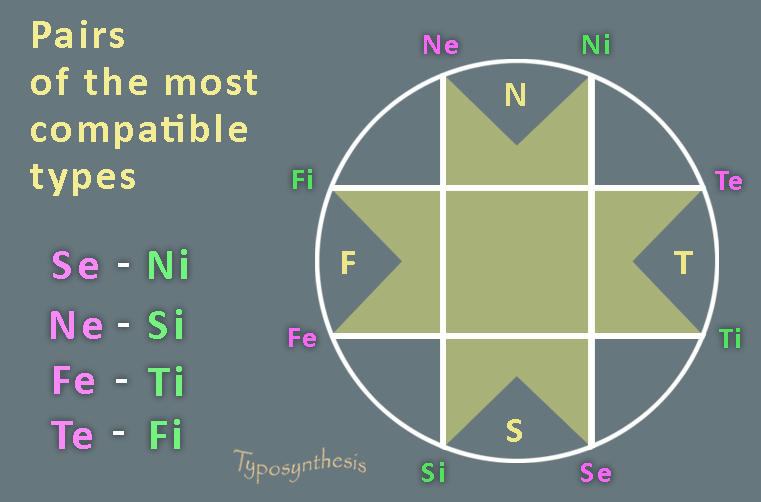
Dualization is complete if the auxiliary functions of the types are opposite. For example, Se type with auxiliary Ti + Ni type with auxiliary Fe (SeTi + NiFe), or Se type with auxiliary Fi + Ni type with auxiliary Te (SeFi + NiTe). In such a couple, the anima/animus of one partner is identical to the main (dominant) function of the other partner. (More information about the anima/animus as a function here >>>) This contributes to the psychological harmonization of each partner. The partners can spend a lot of time together and get tired of each other. Such relationships can last a lifetime.
Conditions for Dualization
The success of a relationship largely depends on the level of harmony of the partners. Dualization is possible if the partners have similar level of harmony (more about the levels of harmony here >>>). If the partners' levels differ significantly, dualization will not occur. For example, if one partner is at the level of social role and the other is at the level of manipulation, there will be no resonance between them, since the partner at the social role level will act constructively (win-win), while the other partner, at the manipulation level, will act destructively (win-lose).
Description of dual relationships on the wikisocion website >>>
If the auxiliary functions of the types are the same, the relationship is called semi-duality and has a different nature. For example, Se-type with auxiliary Ti-function + Ni type with auxiliary Te (SeTi + NiTe), or Se type with auxiliary Fi + Ni type with auxiliary Fe (SeFi + NiFe).
Description of semi-dual relationships on the wikisocion website >>>
• Parallel relationships – partners seem to live in parallel worlds. These are the relationships between the types: Se + Ne, Si + Ni, Fe + Te, Fi + Ti. Initially, these types show interest in each other. Communication at a far psychological (social) distance is quite pleasant. When getting closer, both partners get the impression that their interaction is too superficial, the partners do not understand each other's needs and unable to support each other. The situation worsens when they begin living together. They fail to understand each other's interests; what is important to one has no value to the other. Over time, the partners drift apart, and even living in the same territory, it may seem to them that they are living in parallel worlds.
Depending on the auxiliary function, parallel relationships are divided into two kinds: business and super-ego.
If the auxiliary functions of the types are the same, the relationship is called business or look-a-like. Example, Se type with auxiliary Ti + Ne type with auxiliary Ti (SeTi + NeTi), or Se type with auxiliary Fi + Ne type with auxiliary Fi (SeFi + NeFi). Such relationships are considered optimal for business interaction.
Description of business relationships on the wikisocion website >>>
If the auxiliary functions of the types are different, the relationship is called super-ego and has a different nature. Example, Se type with auxiliary Ti + Ne type with auxiliary Fi (SeTi + NeFi), or Se type with auxiliary Fi + Ne type with auxiliary Ti (SeFi + NeTi). Such relationships are considered worse than business relationships. In super-ego relationships, people are advised to maintain psychological (social) distance. When the distance is reduced, representatives of these types greatly irritate each other.
Description of super-ego relationships on the wikisocion website >>>
• Relationships of extinguishment - the strengths of one partner extinguish the strengths of the other. These are the relationships between the types: Se + Si, Ne + Ni, Fe + Fi, Te + Ti. In such a couple, each partner needs support for his/her inferior function (anima/animus), but the other cannot meet this need.
Initially, these types show interest in each other. Communication at a far psychological (social) distance is quite pleasant. When getting closer, both partners get the impression that their interaction is too superficial, the partners do not understand each other's needs and unable to support each other. The situation worsens when they begin living together. They fail to understand each other's interests; what is important to one has no value to the other. Over time, the partners drift apart, and even living in the same territory, it may seem to them that they are living in parallel worlds.
Depending on the auxiliary function, relationships of extinguishment are divided into two kinds: mirage and extinguishment.
If the auxiliary functions of the types are different, the relationship is called mirage or illusionary. Example, Se type with auxiliary Ti + Si type with auxiliary Fe (SeTi + SiFe), or Se type with auxiliary Fi + Si type with auxiliary Te (SeFi + SiTe). In such a couple, the auxiliary functions of the types are dual, thanks to which the mirage relationships can be comfortable.
Description of mirage relationships on the wikisocion website >>>
If the auxiliary functions of the types are the same, the relationship is called extinguishment or contrary and has a different nature. Example, Se type with auxiliary Ti + Si type with auxiliary Te (SeTi+ SiTe), or Se type with auxiliary Fi + Si type with auxiliary Fe (SeFi + SiFe). In relationships of extinguishment, people are advised to maintain psychological (social) distance. When the distance is reduced, representatives of these types greatly irritate each other. An introvert extinguishes the activity of an extravert: he/she may blame and criticize the extravert.
Description of relationships of extinguishment on the wikisocion website >>>
• Relationships of amplification – the partners' strengths coincide and magnify each other. These are the relationships between the same types: Se + Se, Si + Si, Fe + Fe, Fi + Fi, Te + Te, Ti + Ti, Ne + Ne, Ni + Ni. In such a couple, each partner needs support for his/her inferior function (anima/animus), but the other cannot meet this need.
Depending on the auxiliary function, relationships of amplification are divided into two kinds: identity and kindred.
If the auxiliary functions of the types are the same, the relationship is called identity. Example, Se type with auxiliary Ti + Se type with auxiliary Ti (SeTi + SeTi), or Se type with auxiliary Fi + Se type with auxiliary Fi (SeFi + SeFi). In this couple, the partners' strengths are amplified, but there is no support for their weak points. This often creates instant rapport between two people. They have a feeling of complete understanding, a sense of being on the same wavelength, as if they have met “their” person, when communicating there is often a surge of energy. However, the longer the communication, the more the partners get tired of each other, of oversaturating their main function and of one-sidedness.
Such relationships are best for friendship, teacher-student, and parent-child relationships. Relationships of amplification are especially beneficial for people who did not receive energy for their main function in childhood because their parents belonged to a different type. Such relationships are also useful for seeing oneself from an outside perspective, exploring one's strengths and weaknesses. Such relationships are not recommended for married life.
Description of relationships of identity on the wikisocion website >>>
If the auxiliary functions of the types are different, the relationship is called kindred or comparative. Example, Se type with auxiliary Ti + Se type with auxiliary Fi (SeTi + SeFi). The common main function makes it easier to establish a connection and understanding between these types, while the different auxiliary functions reflect different ideas about how knowledge and skills should be applied.
Kindred types are more likely to form couples than identical types. Kindred couples between two introverts are more common than kindred couples between two extraverts. This is attributed to the fact that it is easier for extraverts to change partners if they are dissatisfied in the relationship. Introverts usually find it more difficult to change partners, so they are more likely to stay in relationships that are uncomfortable for them.
Description of kindred relationships on the wikisocion website >>>