

Jungian typology, cross-cultural psychology, and the national character of China.
Does the MBTI necessitate recalibration for the Chinese contexts?
Українською тут >>>
Type of China >>>
Should the MBTI need to be modified? >>>
Historically, personality types among people are distributed unevenly. In every country—and even in every city or village—certain personality types predominate over others. The personality type that prevails within a population is referred to as the common, national, or integral personality type of that country (or city, village). It shapes the country’s mindset and culture.
In this article, we will explore which personality type predominates among the Chinese population and how this manifests in people’s behavior.
First, let’s look at how people from other countries view the Chinese. A description from Richard Lewis’s book “When Teams Collide” will serve as a good example:
“Kong Dehai is a mainland Chinese who worked several years for IBM in China... Now a member of an international team belonging to a European company with extensive interests in China… Kong is humble, modest, kind, considerate, dutiful, respectful, loyal, sincere, and courteous. Imbued by a sense of hierarchy, his respect extends to his team leader, colleagues, even subordinates and opponents. Thinking collectively, he readily exhibits the necessary ingredients for team working: punctuality, conscientiousness, work ethic, diligence, tenacity, stamina, and, when appropriate, self-sacrifice.
Like most Chinese of a certain age, Kong seems to evince a kind of ancient wisdom, displaying moderation, frugality, gentleness, huge reserves of patience and tolerance, quick generosity, as well as a refreshing proclivity for self-disparagement (“My immature opinion is…”). Britons and Finns often excel in self-deprecation (in the Finnish case self-effacement), but nobody can outdo the Chinese in this area. Humility, as prescribed by Confucius, is one of the cornerstones of Chinese behavior; any form of ostentation or boasting is an absolute taboo. The greater one’s ability to demonstrate personal humility, the higher the esteem one will enjoy.
Kong, a good and careful listener during team discussions, follows the usual Chinese practice of asking others to speak first, just as he would when negotiating with opponents… Modestly, he asks the team leader if he may speak, as opposed to barging in like German and French members do.
On the occasions when Kong is called on to negotiate on behalf of the team, his colleagues see quite a different side of his character… Kong reveals himself as a canny, tough negotiator in the time-honoured Chinese tradition. To begin with, he avoids getting down to business with the other party, preferring to spend an inordinate amount of time chatting about anything but the deal in hand, socializing, eating and drinking with his adversary, getting to know them in a friendly, unhurried manner. When the business discussion eventually starts, Kong uses his incipient “friendship” (on the back of excessive entertaining) as a tool to ask for concessions.
In his own team circle, Kong is regarded somewhat warily by some colleagues ... For one thing, he rarely seems to give straight answers to straight questions and, slightly annoyingly, he doesn’t seem to ask straight questions, either. He is a master of the oblique, only hinting at positives and negatives and rarely coming down hard on either side ... And certainly, he frequently says what he thinks you want to hear… He also flatters us a lot and frequently sneaks us little gifts, which annoys us, as we don’t know what to give back. We can’t decline the little presents, as the manager says this would cause him to lose face and it has been drummed into us often enough that the dominant factor in an Asian’s behavior is protecting everybody’s face, so we do this diligently and go to great lengths not to upset or criticize Kong. This can be quite a strain in the long run, as we are not innately polite like he is. And he is so status conscious. He’s certainly respectful to the manager, but always contrives to sit on his immediate right, which, as we are told, denotes him as the second most important personage in the room (or would in China, at any rate). We don’t mind this too much, but he does have a tendency to moralize (to westerners) and often hints at the numerous Chinese virtues (we sometimes wonder about their modesty!).
Although we like direct questions and answers (and Kong often fails us in this regard), he lacks no directness when it comes to grilling us about personal details. In this respect, he appears just as inquisitive as Indians, who have no qualms about invading our privacy. “Are you married, Mr Lowe? No? Don’t you ever feel lonely? Do you have any children? How old are you? What is your income? How much did the watch you are wearing cost? I hope you are in good health? Do you have any brothers or sisters? Are your parents well?” Of course, we impute the best motives for this curiosity, but Germans, Brits, Swiss, Norwegians, Swedes, and Finns are not comfortable with these incursions. French, Italians, and Americans don’t seem to mind.” (1)
This style of behavior is entirely consistent with the characteristics of Chinese culture and mindset, which have been discussed in numerous articles on the specifics of doing business in China:
Face Value. The Chinese people have high “face value”. Having face means having a high status and prestige in the eyes of one's peers, and it is a mark of personal dignity. The Chinese are very sensitive to having and maintaining face in all aspects of social and business life… The easiest way to cause someone to lose face is to insult the individual or to criticize him/her in front of others. (2) Causing loss of face – even inadvertently – looks like: contradicting someone's position directly in front of their team; rejecting a proposal without diplomatic framing; pointing out an error publicly. (3)
Protection of the face and reputation of all partners, colleagues and even employees is mandatory at all times. Every action or utterance undertaken by a Chinese during his working day or social intercourse is dominated by his estimation of whose reputation is being affected. (4)
Just as face can be lost, it can also be given by praising someone for good work in front of peers or superiors… You may consider allowing your opponent to win in a game like golf even if you are a better player in order to save his or her face. (5) One can also save someone's face by helping him/her to avoid an embarrassing situation (2)
A person can lose face on his own by not living up to others’ expectations, by failing to keep a promise or by behaving disreputably. (4)
Losing face is more important to a Chinese manager than to a Western one, and is felt more deeply ... Chinese try to avoid any public embarrassment and criticism by minimising or covering up big mistakes. (6)
Chinese concern about consensus. Direct refusal – "no, we can't do that" – is a face-threatening act in Chinese professional culture. It puts the person making the proposal in a position of public rejection. Instead, disagreement is communicated through indirection. Qualifiers, hesitations, expressions of difficulty, enthusiasm for the concept without commitment to the specific proposal, or changing the subject – these are the signals. A positive-sounding statement that is light on specific next steps is often communicating exactly what a direct "no" would communicate in a German or American meeting. (3)
The Confucian Ethical Code which was generally known as "Li" adopted to govern or regulate people's behaviors in order to establish a good moral order in society and maintain a harmonious relationship between people… Chinese people held the idea that family members should be strongly tied to their families so that, if one family member gains his/her honor, he/she will bring the honor to all the other family members, and, if one family member damages his/her honor, he/she will damage the honor of all the other family members. (7)
In business interactions, a person's face is not only his own but also the entire organization that he/she represents. A foreigner's relationship with the individual and the respect accorded him/her is probably the key to their business success in China. (2)
The guanxi concept of mutual back-scratching and networking. In Chinese business practices, there is a strong emphasis on building long-term relationships and networks (guanxi), which are rooted in trust and mutual obligations. This approach contrasts with Western business models that often prioritize short-term gains and contractual agreements. (8)
A foreign businessman must cultivate close personal ties with business associates and earn their respect and trust. (5) Relationships, once established, must be maintained in the long term. The cultivation of these may be hard work and time-consuming. It must remain a high priority. (4)
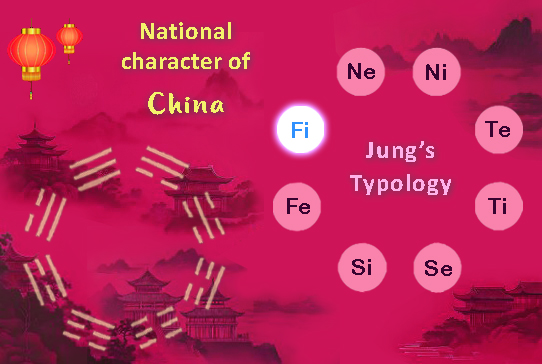
It is evident that all of the above corresponds to the core characteristics of the Jungian Feeling Introverted (Fi) type. A description of the Fi type at different levels of psychological harmony can be found here >>>
The concept of "face" reflects the Fi type’s concern with morality, behavioral norms, and one’s reputation in the eyes of others. The Fi type’s inherent focus on family, harmonious relationships, responsibility, and the stability of a community (whether a family, a team, or a nation) is clearly evident within the Chinese mindset.
Social stability is ensured by maintaining long-term relationships based on mutual trust and responsibility. When a Chinese person asks Westerners about their so-called personal details, they are actually trying to understand how much that person respects their parents, what their relationship with their family is like, and how decent they are. Based on these indicators, a Chinese person assesses how trustworthy an individual is and whether he is ready to maintain long-term relationships and fulfill mutual obligations.
There are two versions of the Fi type: Fi with Intuition (N) and Fi with Sensation (S). The Chinese population is represented by the Fi type with Intuition (Fi-N).
To better understand the worldview of the Fi type, one can read the works of Fyodor Dostoevsky or Erich Fromm, who are both Fi types with Intuition (Fi-N). Dostoevsky explores moral dilemmas through fiction, whereas Fromm examines them in a philosophical and psychological context. In his book “Man for Himself”, Fromm addresses themes that most concern Fi type: humanistic ethics; subjective versus objective ethics; humanistic and authoritarian conscience; the moral powers in man; man, good or evil?; character and moral judgment.
In 2025, a paper was published regarding the specifics of romantic relationships in modern China, titled " Personality typology, emotional needs, and romantic relationship stability in Chinese college students: A cultural perspective on MBTI dynamics " (8). Below are some key points from the article:
“Western romantic models tend to emphasize dyadic satisfaction, focusing on individual needs and mutual gratification within relationships... Chinese romantic relationships are embedded within hierarchical family networks, often suppressing individual desires for the sake of collective harmony… In China, there is a strong emphasis on fulfilling social obligations.
“Face” plays a pivotal role in regulating emotional labor within Chinese interpersonal relationships, where indirectness and contextual sensitivity are culturally valued. Unlike Western norms that often promote open emotional expression, Chinese individuals may engage in indirect relational repair behaviors such as chore-sharing or gift-giving rather than verbal affirmation. This pattern aligns with Matsumoto, findings on cultural display rules, which highlight how collectivist cultures promote emotional restraint to maintain social harmony.
In Western contexts, MBTI NF types are consistently associated with heightened emotional expressiveness and a strong emphasis on personal self-actualization within romantic relationships. … Our findings partially align with this pattern, as Chinese NF types also demonstrate high emotional needs and stability. However, the expression of these needs in China is often channeled through culturally sanctioned pathways, such as filial piety and relational obligations, rather than direct personal disclosure.”
The paper states that, in a Western context, NF types (according to the MBTI) are typically associated with heightened emotional expressiveness, whereas Chinese culture encourages emotional restraint. Introverted Feeling (Fi) types, in contrast to Extraverted Feeling (Fe) types, are characterized by a high level of self-discipline and the suppression of their emotions to maintain harmonious relationships with those around them.
Countries where the Fi type predominates are characterized by emotional restraint in social interaction. In addition to China, such countries include Ukraine, Switzerland (Fi-S), and Canada (Fi-N). Emotional restraint, communication etiquette, and solid traditional views are also evident in Britain, where the Fi-N type ranks second in the country’s typological structure.
The Amish community, which can be likened to a small nation, also deserves mention. Like many other religious communities, the Amish align with the Fi type; Fi types naturally strive to be part of a group, are inclined toward devotion to moral or religious ideals, asceticism, and strict adherence to codes of conduct.
The Fi type is also known as the "Perfectionist." In psychological literature, this type is referred to as the Obsessive-Compulsive personality.
Does the MBTI necessitate recalibration for the Chinese contexts?
The authors of the paper write: “While the Myers-Briggs Type Indicator (MBTI) framework is widely applied, its Western-centric assumptions necessitate recalibration for East Asian contexts. The Chinese Personality Assessment Inventory (CPAI), developed by Cheung and colleagues, introduces the indigenous dimension of “Interpersonal Relatedness,” which emphasizes harmony, relational obligations, and social norms… This dimension enriches the understanding of MBTI Feeling (F) types by highlighting relational ethics, obligation, and harmony as central facets of emotional expression in Chinese cultural settings, thus challenging Western-centric interpretations of emotional needs in romantic relationships.” (8)
In the MBTI system, the Extraverted Feeling type (Fe) and the Introverted Feeling type (Fi) are not distinguished as separate types. However, in his book, Carl Jung described the Extraverted Feeling type (Fe) and the Introverted Feeling type (Fi) separately. In the MBTI test, the Introverted Feeling type (Fi) is defined as a preference for the Feeling function over the Thinking function on the Feeling (F)–Thinking (T) scale, combined with a preference for introversion over extraversion on the Extraversion–Introversion scale. This is very vague and generalized, and does not capture the essence of the Fi type.
In 1993 at the conference of the Association of Psychological Type in California John Beebe (Jungian analyst) reminded the audience that Jung’s original scheme was comprised not just of four functions (S, N, T, F) but of four functions in two attitudes, i.e., eight function-attitudes. Before 1993, type practitioners had limited themselves to "the preferences,” as Myers termed the four scales of her model (ЕЛ, N/S, T/F, J/P)… Myers herself knew the differences between, for example, introverted feeling (Fi) and extraverted feeling (Fe), but she wanted to create something accessible to a broad public and so tried to provide the simplest, most general introduction to the topic. (9)
Should the MBTI need to be modified?
Modifying the MBTI test is overly complicated. It is easier to create one's own test based on detailed descriptions of the eight Jungian functions. Such descriptions can be found in socionics.
Two separate systems, Socionics and the MBTI, grew from the Jung's work “Psychological Types” in near-total isolation from each other. Both Socionics and the MBTI define 16 types and share much of the same vocabulary.
Socionics was developed in the 1970s and 80s, in Lithuania, which was then part of the Soviet Union. In 1991, the International Institute of Socionics was founded in Kyiv (Ukraine), where international conferences on Socionics are held annually. Socionics was largely unknown outside Eastern Europe until the internet made it accessible.
In Socionics, the psychic function Fi is called Ethics of relations or introverted Ethics.
A description of the socionic Fi type (function) in English can be found on the following websites:
- Viktor Gulenko’s website socioniks.net
- A modern English-language website that gathers all available information on Socionics www.socionicsinsight.com
- An archive of Rick DeLong’s Socionics website (Rick DeLong) wikisocion.github.io
- Sergey Ionkin’s website practicalsocionics.com
Although Socionics identifies 16 types, the emphasis is placed on the 8 functions that underlie these 16 types. Without understanding the 8 functions, it is impossible to understand the 16 types. Socionics makes a clear distinction between the Extraverted Feeling function (Fe) and the Introverted Feeling function (Fi). Both functions are described in detail. Given this level of detail, the description of the Fi function is identical to the description of the Fi type.
However, the main reason why the MBTI cannot be modified lies in its legal status. Here is what the website www.socionicsinsight.com says about this:
“Socionics developed in an Eastern European academic context. Its authors were researchers with no commercial product to sell. The system has been debated, revised, and contested by a community of practitioners who are primarily interested in whether it is correct, not whether it is marketable.
The MBTI developed in a Western commercial context. It is a proprietary instrument owned by a trust, administered through licensed practitioners, and defended against criticism partly for institutional reasons. Its four-letter framework has become a cultural shorthand — a way of talking about personality that is recognised everywhere, regardless of whether the underlying model is sound.”
Anzhelika Zabava, november 2026.
...
1 - Richard Lewis ‘When Teams Collide: Managing the International Team Successfully’ Chapter 5 Team Members’ Profiles: China. 2012
2 - XuHua Zhang. Cross-cultural communication: the way to do business in China. Journal of Organizational Culture, Communications and Conflict, 2003.
3 - Julian Johns. What Is Mianzi? CultureFlow, 2026
4 – Forum hercegbosna.org
5 - The business environment in Hong Kong. Delhi Business Review, 2000
6 - Gregory E. Osland. Doing Business in China: A Framework for Cross‐cultural Understanding. Marketing Intelligence & Planning. 1990
7 - Ling Zhou, Shao-jie Zhang. How face as a system of value-constructs operates through the interplay of mianzi and lian in Chinese: a corpus-based study, 2017
8 - Jiaxin Li, Gu Fang, Yiyang Li. Personality typology, emotional needs, and romantic relationship stability in Chinese college students: A cultural perspective on MBTI dynamics, 2025 link >>>
9 - Carol Shumate. Projection and Personality Development via the Eight-Function Model. The war between the attitudes. 2021