

Anima/animus as psychic functions. The dual nature of the psyche
Українською тут >>>
- Duality of the psyche, compensation
- Anima/animus as functions
In his work, Psychological Types, Carl Jung described eight distinct personality types. He proposed the concept of four main psychic functions: Sensation, Feeling, Thinking and Intuition. (More on this here >>>) Each of these functions has two variants: extraverted and introverted, and together there are eight psychic functions, 4 introverted and 4 extraverted:
• Sensation Extraverted - Se, • Sensation Introverted – Si
• Feeling Extraverted - Fe, • Feeling Introverted – Fi
• Thinking Extraverted - Te, • Thinking Introverted - Ti
• Intuition Extraverted – Ne, • Intuition Introverted – Ni
All eight functions are present in the psyche of each person, however, one of the functions always surpasses the others in strength and speed of reaction. It is called the main or superior one. If the main function is Sensation Extraverted (Se), then the type is called Sensing Extraverted, if the main function is Feeling Introverted (Fi), then the type is called Feeling Introverted, etc.
Duality of the psyche. Jung discovered that the human psyche has a dual nature, the main function of a type is always balanced by an opposite psychic function. Jung called this complementarity of opposite functions COMPENSATION.
“Compensation means a balancing or supplementing… Whereas Adler restricts his concept of compensation to a mere balancing of the feeling of inferiority, I conceive it as a general functional adjustment, an inherent self-regulation of the psychic apparatus. In this sense, I regard the activity of the unconscious as a compensation to the onesidedness of the general attitude produced by the function of consciousness (main function) … Compensation by the unconscious is, as a rule, not so much a contrast as a levelling up or supplementing of the conscious orientation.” – from ‘Psychological Types’ (1)
The extroverted attitude is compensated by the introverted attitude, Sensation (S) is compensated by Intuition (N), Feeling (F) is compensated by Thinking (T). These pairs of opposites are also complementary and interdependent.
Jung writes: “The extraverted feeling type, as a rule, represses his thinking (T), just because thinking is the function most liable to disturb feeling (F)... The repression of thinking, as I observed before, is complete only in so far as its inexorable logic forces it to conclusions that are incompatible with feeling. It is suffered to exist as the servant of feeling, or more accurately its slave… Now, since a logic exists producing inexorably right conclusions, this must happen somewhere, although beyond the bounds of consciousness, i.e. in the unconscious. Pre-eminently, therefore, the unconscious content of this type is a particular kind of thinking. It is an infantile, archaic, and negative thinking (T).” (2)
The compensatory function is always weaker and slower than the main function. The compensatory function can be either completely repressed into the unconscious or fully conscious. If the main function excessively represses the opposite compensatory function, the compensatory nature of the function is lost, and a typological inversion occurs. An individual acquires qualities of the opposite type; for example, a thinking type (T) begins to behave like a feeling type (F), but their feelings are primitive and uncontrollable.
“Wherever an exaggeration of the conscious standpoint (main function) takes place, the unconscious also comes to light in a symptomatic form, i.e. the unconscious egoism, infantilism, and archaism lose their original compensatory characters, and appear in more or less open opposition to the conscious attitude… It is a salient peculiarity of unconscious tendencies that, just in so far as they are deprived of their energy by a lack of conscious recognition, they assume a correspondingly destructive character, and as soon as this happens their compensatory function ceases.” (3)
This is how Jung describes the compensatory function of the Thinking type (T): “The unconscious also contains functions which under other circumstances can become conscious. The thinking type (T), for example, must necessarily always suppress and exclude feeling (F), since nothing disturbs thinking so much as feeling... Repressed functions lapse into the unconscious… By this ‘unconsciousness’ I do not of course mean that an intellectual, for example, would be unconscious of feeling. He knows his feelings very well, in so far as he has any power of introspection, but he gives them no value and allows them no influence. They happen to him, as it were, against his intention; being spontaneous and autonomous, they finally possess themselves of the validity which consciousness denies… The unconscious feelings of the thinking type are of a singularly fantastic nature, often in grotesque contrast to the excessively rationalistic intellectualism of his conscious attitude. His conscious thinking (T) is purposive and controlled, but his feeling (F) is impulsive, uncontrolled, moody, irrational, primitive, and just as archaic as the feelings of a savage.” (4)
Thus, the struggle and union of opposites are inherent in human.
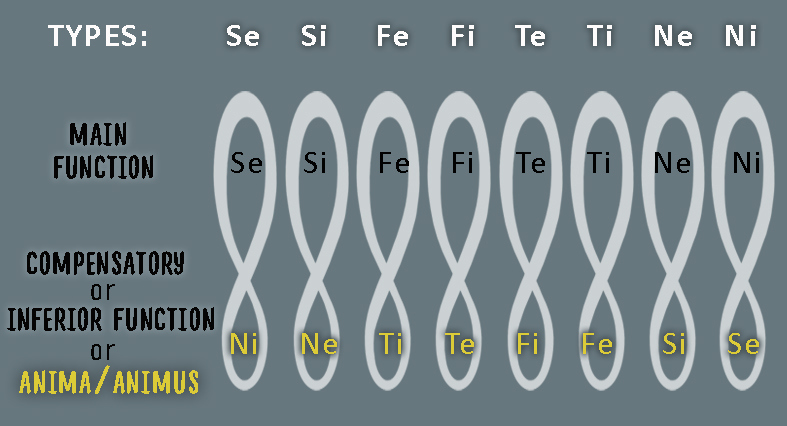
The following pairs of functions are compensatory, balancing, or dual: Se – Ni, Si – Ne, Fe – Ti, Fi – Te. That is, if a type's main function is Se, then the compensatory function will be Ni, and vice versa: if a type's main function is Ni, then the compensatory function will be Se. Carl Jung subsequently refers to the compensatory function as the inferior function. Here are the different names for the main and compensatory functions, using the Se type as an example:
|
Se |
Ni |
|
|
Carl Jung |
Primary, Superior, Main, Conscious attitude, Differentiated, Most developed |
Fourth, Inferior, Compensatory |
|
MBTI |
Dominant |
Inferior |
|
Socionics |
Leading, Main, Program, Primary, Base |
Suggestive, Dual |
So, when we say ‘Se type,’ we mean at least two functions that are related to each other: Se – Ni. The Ni function complements and balances the main Se function. When we say ‘Ni type,’ we mean at least two functions: Ni – Se. The Se function complements and balances the main Ni function.
In his book, Psychological Types, Carl Jung describes a state of compensation and the process of losing compensation for each of the eight types. Here is how he describes the compensatory function Se for the type with the main function Ni: “The introverted intuitive's (Ni) chief repression falls upon the sensation of the object… For we find in his unconscious a compensatory extraverted sensation function of an archaic character. The unconscious personality may, therefore, best be described as an extraverted sensation-type (Se) of a rather low and primitive order. Impulsiveness and unrestraint are the characters of this sensation, combined with an extraordinary dependence upon the sense impression... If, through a forced exaggeration of the conscious attitude (main function), a complete subordination to the inner perception should develop, the unconscious becomes an opposition, giving rise to compulsive sensations whose excessive dependence upon the object is in frank conflict with the conscious attitude.” (5)
Anima and animus as functions of the psyche. In his works, Jung attributes various meanings to the anima/animus. He calls them the soul and archetypes. He also considers the animus to be the personification of unconscious masculinity in women, and the anima to be the personification of femininity in men. In addition, Jung refers to the anima/animus as psychic functions.
“With the same justification as daily experience furnishes us for speaking of an outer personality are we also justified in assuming the existence of an inner personality. The inner personality is the manner of one’s behaviour towards the inner psychic processes; it is the inner attitude, the character, that is turned towards the unconscious. I term the outer attitude, or outer character, the persona, the inner attitude I term the anima, or soul… Where the persona is intellectual, the soul is quite certainly sentimental… The inner attitude corresponds with just as definite a function-complex as the outer attitude…” – from ‘Psychological Types’ (6)
In his lecture on Nietzsche's psychological characteristics, Jung explains: “The archetype has absolutely no interest in differentiating the functions because it is the totality of all functions… The anima would be the personification of the inferior function; the anima is chiefly fed by the inferior function, in this case inferior feeling, so the inferior function and the anima are one and the same under two aspects; one is the scientific formulation and the other is the phenomenological. Of course it is a function, in whatever form it appears.” (7)
Like the compensatory function, the anima/animus are opposite to the main function. If the main function is extraverted, the anima or animus is introverted; if the main function is Sensation (S), the anima/animus is Intuition (N); if the main function is Thinking (T), the anima/animus is Feeling (F).
Here is what Jung writes about Nietzsche's anima: “The anima side of him would choose a world consisting chiefly of personal relations, and inasmuch as he is introverted his anima would have an extraverted character.” (8)
“Intellect (T) and feeling (F) are difficult to put into one harness — they conflict with one another by definition. Whoever identifies with an intellectual standpoint (T) will occasionally find his feeling (F) confronting him like an enemy in the guise of the anima; conversely, an intellectual (T) animus will make violent attacks on the feeling standpoint (F). Therefore, anyone who wants to achieve the difficult feat of realizing something not only intellectually, but also according to its feeling-value, must for better or worse come to grups with the anima/animus problem in order to open the way for a higher union, a coniunctio oppositorum (union of opposites). This is an indispensable prerequisite for wholeness.” (9)
In his book, Psychology and Alchemy, Carl Jung analyzes his client's dreams and explains the connection of the symbols in these dreams with psychic functions, as well as with the anima/animus: “The unknown woman or anima always represents the “inferior,” i.e., the undifferentiated function, which in the case of our dreamer is feeling (F).” (10) “The dreamer had not noticed before how possessed he was by the intellect (T) as the tacitly recognized supreme power. Now he has a chance to view this function, which till then had been the uncontested dominant of his psychic life”. (11)
If an individual's main function is Se, then the anima/animus will be represented by the Ni function, and vice versa, if an individual's main function is Ni, then the anima/animus will be represented by the Se function. Thus, we have the following pairs of functions: Se – Ni, Si – Ne, Fe – Ti, Fi – Te.
This means that the compensatory function is identical to the inferior function, as well as to the concept of anima/animus as a function. That is, the anima or animus possess the same properties as the compensatory function: the anima/animus complements and balances the main function.
Since the inferior function varies between different types and can be represented by either Feeling or Thinking, or by Sensation or Intuition, the anima and animus may not map onto some notions of masculine or feminine qualities. In a man with the main Thinking function, the anima will be represented by the Feeling function, which corresponds to feminine qualities, but in a man with the main Feeling function, the anima will be represented by the Thinking function, which does not correspond to notions of feminine qualities. The same thing goes for the animus. In a woman with the main Feeling function, the animus will be represented by the Thinking function, which corresponds to masculine qualities. However, in a woman with the main Thinking function, the animus will be represented by the Feeling function, which does not correspond to notions of masculine qualities.
Jung's concept of psychological types and functions changed over time. At first (1913), Jung divided all people into only two class: extraverts and introverts (a). Later, he discovered other psychic functions, but believed that all introverts were Thinking types, and all extroverts were Feeling types. (b) He considered himself an introverted Thinking type, so naturally, so it was natural that he based his concept of types on his own perception. While writing the work "Psychological Types" (1921), he believed that men were mainly Thinking types, and women were mainly Feeling types. (c) This is probably where the conclusion came from that in men, the anima represents Feelings, and in women, the animus represents Thinking.
(a) – In a lecture in 1928, Jung says: “The contrast between introversion and extraversion is simple enough, but simple formulations are unfortunately the most open to doubt. They all too easily cover up the actual complexities and so deceive us. I speak here from my own experience, for scarcely had I published the first formulation of my criteria (a lecture delivered at the Psychoanalytical Congress in 1913) when I discovered to my dismay that somehow or other I had been taken in by them. Something was amiss. I had tried to explain too much in too simple a way, as often happens in the first joy of discovery. What struck me now was the undeniable fact while people may be classed as introverts or extraverts, this does not account for the tremendous differences between individuals in either class. So great, indeed, are these differences that I was forced to doubt whether I had observed correctly in the first place. It took nearly ten years of observation and comparison to clear up this doubt.” (12)
(b) - In his book ‘Psychological Types’, 1921, Jung writes: “In my earlier publications I identified the introvert with the thinking and the extravert with the feeling type. As I have said before, it became clear to me only later that introversion and extraversion are to be distinguished as general basic attitudes from the function-types. These two attitudes may be recognized with the greatest ease, while it requires considerable experience to distinguish the function-type. At times it is uncommonly difficult to find out which function holds prior place. The fact that the introvert, because of his abstracting attitude, naturally has a reflective and contemplative air is misleading. One is inclined to assume that in him the primacy falls to thinking. The extravert, on the contrary, naturally displays many immediate reactions, which easily lead one to conjecture a predominance of feeling. These suppositions are deceptive, since the extravert may well be a thinking, and the introvert a feeling type.” (13)
(c) – In his book ‘Psychological Types’, 1921, Jung writes: “In so far as Feeling is, incontestably, a more obvious peculiarity of feminine psychology than Thinking, the most pronounced feeling-types are also to be found among women. When extraverted feeling possesses the priority we speak of an extraverted feeling-type. Examples of this type that I can call to mind are, almost without exception, women.” (14)
Last updating 26.12.2025
* *
1 - Carl Jung “Psychological Types”, 1921. Chapter XI. Definitions. 10. Compensation.
2 - Carl Jung “Psychological Types”, 1921. Chapter X. 4. The Extraverted Feeling-Type
3 - Carl Jung “Psychological Types”, 1921. Chapter X. B. The Extraverted Type (II) The Attitude of the Unconscious
4 – Psychological Types. A lecture delivered by Carl Jung, Territet, Switzerland, 1923.
5 – Carl Jung “Psychological Types”, 1921. Chapter X. 9. The Introverted Intuitive Type
6 - Carl Jung “Psychological Types”, 1921. Chapter XI. Definitions 48. Soul (anima).
7 - Jung's Seminar on Nietzsche's Zarathustra, Lecture 2, 9 May 1934.
8 - Jung's Seminar on Nietzsche's Zarathustra, Lecture 2, 23 October 1935.
9 - Carl Jung “Aion.” Chapter IV. The Self. Originally published in the Eranos-Jahrbuch 1948.
10 - Carl Jung “Psychology and Alchemy”, 1944. Chapter 3. The Symbolism of the Mandala II. THE MANDALAS IN THE DREAMS Dream 11.
11 - Carl Jung “Psychology and Alchemy”, 1944. Chapter 2. The Initial Dreams. Dream 14.
12 - A psychological theory of types. A lecture delivered at the Congress of Swiss Psychiatrists, Zurich, 1928.
13 - Carl Jung “Psychological Types”, 1921. Chapter IV The type problem in human character 1. General remarks on Jordan’s types.
14 - Carl Jung “Psychological Types”, 1921. Chapter X. 4. The Extraverted Feeling-Type.